


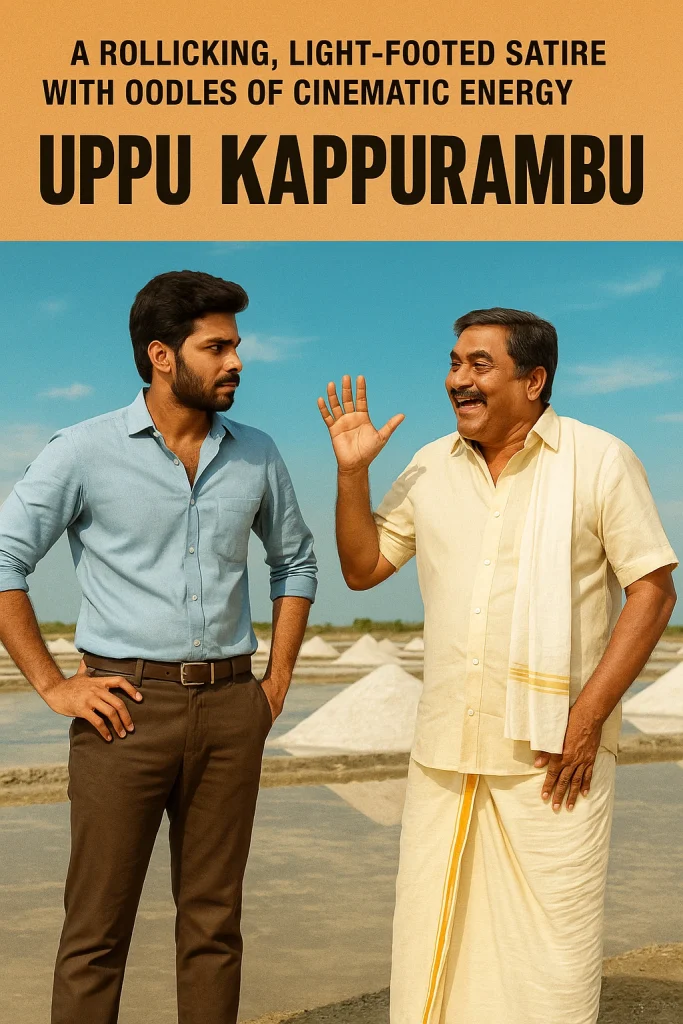
In an era where big-budget spectacle often overshadows nuance, “Uppu Kappurambu” arrives like a gust of salty coastal breeze—refreshing, unpredictable, and full of zing. Directed by debutant filmmaker S. Venu Gopal, this Telugu-language satire dives headfirst into the heartland, stirring up a cocktail of humor, regional pride, and biting social commentary.
Set in a sleepy seaside village brimming with salt pans, superstitions, and simmering egos, Uppu Kappurambu (which literally translates to “Salt and Pepper”) presents a world that is hilariously off-kilter, yet uncannily reflective of the times we live in. It’s cinema that doesn’t take itself too seriously—while slyly asking you to think twice about everything from power, politics, to the petty absurdities of everyday life.
🌊 Plot Summary: Coastal Chaos, With a Dash of Madness
The film opens in the coastal town of Kottavur, where salt mining is the primary livelihood, and gossip travels faster than the sea breeze. The villagers live by a peculiar logic: everything in life can be balanced—like salt and pepper—as long as no one rocks the boat.
But the boat gets thoroughly rocked when Chandrayya (played by the superbly agile Naresh Agastya), a low-ranking revenue officer with idealistic dreams, is transferred to Kottavur. Armed with bureaucratic rulebooks and urban righteousness, he attempts to clean up corruption, implement fair wages in the salt pans, and—most offensively—install a working toilet in the Panchayat office.
This immediately puts him at odds with the unofficial ruler of Kottavur: the charismatic, cunning, and wildly superstitious President Peddayya (brilliantly portrayed by Rajendra Prasad). With a rosary in one hand and a bribe ledger in the other, Peddayya is the kind of political operator who can convince you that daylight savings is an anti-farmer conspiracy.
What ensues is a riot of miscommunications, protests led by cows, confused bureaucrats, rituals gone awry, and a surreal subplot involving a monkey who becomes an internet sensation.
🎭 Performances: Every Character Sizzles With Flavor
Naresh Agastya brings a restrained charm to Chandrayya. He’s not your typical savior-hero but a conflicted government officer slowly learning to play the game without losing his soul. His comic timing is subtle, his earnestness believable, and his slow transformation from outsider to insider forms the emotional arc of the film.
But the real show-stealer is Rajendra Prasad, in what is arguably his best role in recent years. His Peddayya is a delightful paradox—part tyrant, part comic relief, and entirely unpredictable. Watching him explain how salt production is affected by Mercury retrograde is laugh-out-loud funny.
Supporting actors like Ananya Nagalla as the firebrand school teacher Sridevi, and Tanikella Bharani as the world-weary priest, lend strong performances that enrich the ensemble. Even the minor characters—be it the astrologer with a gambling addiction or the Panchayat clerk with a lisp—are written with affectionate absurdity.
🎬 Direction & Screenplay: A Confident, Witty Debut
Director S. Venu Gopal makes a confident debut, walking the tightrope between satire and sincerity. His screenplay is packed with local dialects, idioms, and cultural nuances. There’s a scene involving a village “debate” over whether God prefers turmeric or camphor—shot like a courtroom drama—that has audiences in splits.
The film’s pacing is breezy for the most part, rarely dragging. Gopal cleverly uses hyperlocal metaphors to explore larger themes—how power resists change, how tradition can be both comforting and regressive, and how the “system” adapts to absorb even the rebels.
Standout Moments:
-
A surreal dream sequence where Peddayya imagines himself as a superhero defending “Salt Rights.”
-
A town-wide shutdown because someone sneezed on a holy stone.
-
A TikTok dance protest that turns into a viral movement.
-
A tense climax in a salt pan, shot like a Western standoff—only with salt instead of guns.
🎥 Cinematography & Music: Visual Poetry with a Rustic Beat
Cinematographer Ravi Varman’s apprentice Arun Karthik does wonders with coastal imagery. The white salt plains, the reflective water beds, the orange-hued sunsets—each frame looks like it’s been kissed by sunlight and satire.
The film makes excellent use of visual irony: pristine natural beauty contrasts with the murky morality of its inhabitants. There’s a moment where a villager burns an effigy next to a salt pyramid, and the resulting image is both poetic and politically charged.
Music by Vivek Sagar is another highlight. His background score blends folk rhythms with electronic quirkiness, echoing the film’s blend of tradition and modern chaos. The songs, especially the satirical “Nethuru Panchayathi Lechipoyindi” and the romantic “Chitti Chilakamma,” are catchy without interrupting the narrative flow.
🧠 Themes: Between Satire and Soul
At its core, Uppu Kappurambu is a satirical fable—but it doesn’t just mock. It critiques, celebrates, and finally, empathizes.
Key Themes:
-
Corruption as Culture: The film shows how corruption isn’t just an act—it’s a systemic ritual, woven into the daily fabric of rural governance.
-
The Absurdity of Bureaucracy: From toilet permissions to land records, the film skewers government red tape with hilarious precision.
-
Tradition vs. Progress: The villagers’ resistance to Chandrayya’s reforms isn’t evil—it’s fear of the unknown.
-
The Role of Media: A hilarious arc involving a “viral monkey” turns into commentary on how digital distractions dilute serious issues.
What makes the satire work is its light-footed tone. The film never preaches, never points fingers—it simply holds up a mirror, with a wide, knowing grin.
🧐 Where It Stumbles: Minor Salts in the Pepper
-
The second half could have used a tighter edit. The momentum dips just before the climax.
-
A romantic subplot between Chandrayya and Sridevi, while sweet, feels slightly underdeveloped.
-
Some viewers unfamiliar with rural Andhra slang may miss a few jokes.
That said, these are minor quibbles in a film that dares to be joyfully different.
💬 Critics and Audience Reactions
Upon release, Uppu Kappurambu quickly generated buzz across social media and regional film circuits.
“This is the kind of clever regional satire we don’t see enough of. It’s rooted, rebellious, and riotously funny,” – Baradwaj Rangan, Film Companion
“Rajendra Prasad delivers a performance that belongs in the Hall of Satirical Fame,” – Cinema Express
Audience word-of-mouth has been stellar, especially among urban viewers nostalgic for their village roots, and rural viewers excited to see their dialects and quirks on the big screen.
🏆 Verdict: Salt, Wit, and Sincerity—A Satirical Gem
Rating: ★★★★☆ (4.5/5)
Uppu Kappurambu succeeds where many satires stumble—it never loses sight of its emotional center while delivering laughs at every turn. It’s as much a love letter to Andhra’s villages as it is a sly jab at its political realities.
With pitch-perfect performances, clever writing, and visual verve, the film deserves to be celebrated as one of Telugu cinema’s best surprises of the year.
So grab a ticket, leave your logic at the door, and let this salt-and-pepper comedy season your weekend.
“Because sometimes, all it takes to stir a revolution is a pinch of salt and a lot of laughter.”
🙋 FAQs: Uppu Kappurambu, Answered
Q1. Is the film only for Telugu-speaking audiences?
A: No! Subtitled versions make it accessible. The humor is universal, though regional references add flavor.
Q2. Is it a political film?
A: It’s political only in spirit—the satire is broad and doesn’t target specific parties. It mocks the system, not individuals.
Q3. Is it family-friendly?
A: Yes! There’s no vulgarity or explicit content. Kids may not get every joke, but it’s wholesome overall.
Q4. Will there be a sequel?
A: Rumors suggest a spiritual sequel is in development, exploring another village’s “pepper problem”—but no confirmation yet.
Read More: