


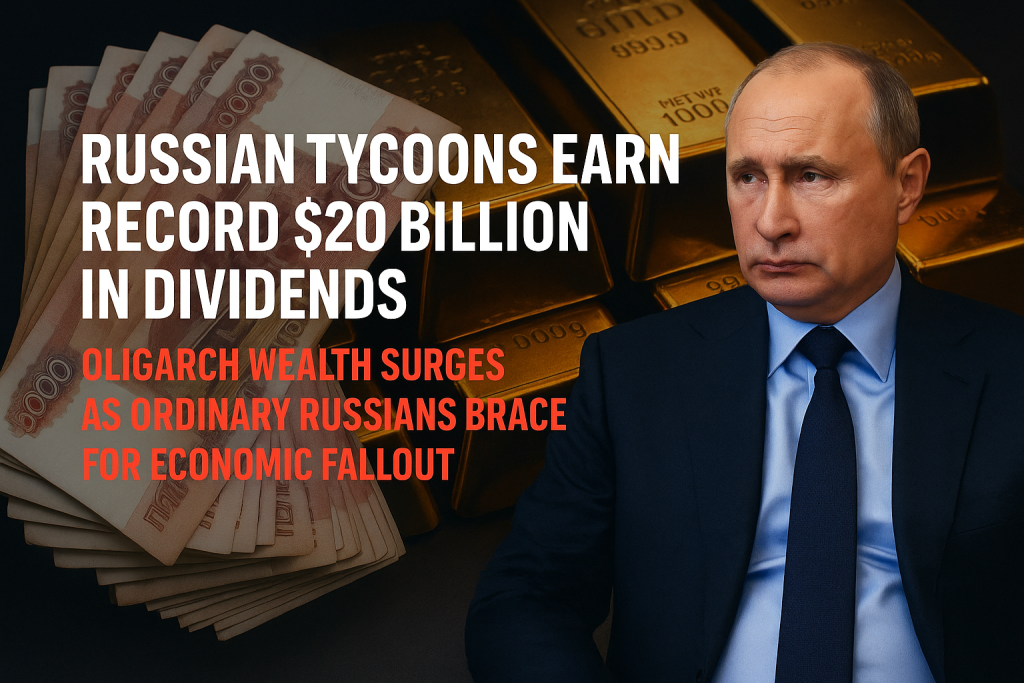
At a time when Russia’s broader economy wrestles with mounting global sanctions, slowing trade, and recession fears, the country’s wealthiest elite have quietly amassed a record windfall. According to recent financial disclosures and market analysts, Russian tycoons earned over $20 billion in dividends in the past fiscal year, marking a historic high despite an economic climate that continues to pressure average households and small businesses.
This paradox — booming billionaire wealth amid a struggling economy — has stirred both domestic debate and global scrutiny. While Moscow continues its campaign of economic resilience and import substitution, critics argue that the concentrated wealth at the top is symptomatic of deeper structural imbalances, further aggravated by geopolitical isolation and military expenditures.
Let’s explore how this $20 billion dividend payout came to be, who the key players are, and what it means for Russia’s financial and political future.
📈 The Billionaire Boom: Breaking Down the Numbers
Despite a flurry of Western sanctions, capital flight, and currency fluctuations, the largest Russian companies — primarily in energy, metals, and banking — recorded robust profits in 2024 and early 2025.
According to data compiled by the Moscow Exchange, top firms including Gazprom, Rosneft, Norilsk Nickel, Lukoil, and Sberbank declared record dividend payouts. These payouts mostly benefit their largest shareholders — Russia’s wealthiest oligarchs, many of whom still wield significant influence in both politics and industry.
“The numbers are astonishing,” says Ekaterina Voronina, a financial researcher at the Center for Russian Economic Policy. “In a year of supposed austerity and ‘war-time economics,’ over $20 billion in dividends flowed to individuals at the very top.”
This figure represents a 30% year-on-year increase in total dividends paid to billionaires, and more than double what was distributed just five years ago, prior to the Ukraine war escalation.
🛢️ Key Contributors: Energy and Metals Dominate
1. Gazprom
The state-backed gas giant remains a cash cow, despite challenges in European exports. Gazprom issued a record dividend of 52.53 rubles per share, amounting to over $7 billion in payouts.
Main beneficiaries include:
-
Alexey Miller (CEO, long-time Putin ally)
-
State holding companies and a network of private shareholders linked to Russian elites
2. Rosneft
Rosneft, the oil titan led by Igor Sechin, another Putin confidante, reported solid profits thanks to higher crude prices and expanded sales to China and India.
-
Dividends exceeded $4.2 billion
-
Sechin is believed to control significant indirect holdings through trusts and intermediaries
3. Norilsk Nickel
Mining magnate Vladimir Potanin, Russia’s richest man, received over $2.5 billion in dividends, thanks to Norilsk Nickel’s profitability in the global metals market. Demand for nickel, crucial for batteries and EVs, has kept profits steady.
4. Lukoil and Tatneft
Privately held oil companies like Lukoil also contributed significantly. Insiders report dividend yields of 10–12%, with Vagit Alekperov, Lukoil’s former CEO, earning hundreds of millions through his remaining holdings.
🏦 Russian Banks Join the Dividend Parade
Surprisingly, Russian banking giants — despite inflation concerns and tighter domestic credit — also joined the dividend surge.
-
Sberbank, Russia’s largest lender, announced a $1.8 billion dividend pool, with portions earmarked for both state and private shareholders
-
VTB and Alfa Bank followed with smaller, yet substantial, payouts
“This points to a dual economy,” says Alexander Kruglov, former economist at the Russian Central Bank. “While households face credit tightening and inflation, the top tier enjoys stable cash flows.”
🔍 How Are Tycoons Cashing Out in a Sanctioned Economy?
With restrictions on overseas assets, travel bans, and banking sanctions, the question arises: how are Russian tycoons accessing and utilizing their dividends?
The answer lies in domestic reinvestment, offshore proxies, and alternative currencies:
-
Many oligarchs have repatriated capital and now operate via the Moscow Exchange and friendly financial hubs in the UAE, Kazakhstan, and China
-
Assets are increasingly held through relatives, shell companies, and crypto wallets
-
A rise in luxury real estate purchases within Russia and other BRICS nations shows how money is being deployed
“Don’t assume the sanctions are stopping the flow of wealth — they’re merely changing its route,” says Voronina.
🧍 Economic Disparity: A Tale of Two Russias
While the elite celebrate a financial bonanza, ordinary Russians face a much harsher economic reality:
-
Inflation remains stubbornly high, hovering around 11%
-
Real wages have stagnated, especially in regions beyond Moscow and St. Petersburg
-
Small businesses continue to struggle with supply chain disruptions and falling demand
-
The ruble has depreciated significantly against stable foreign currencies
“My utility bills went up 22% this year, and my salary stayed the same,” says Dmitry Malov, a schoolteacher in Yekaterinburg. “Meanwhile, they tell us the country is doing great.”
This disconnect has led to growing unease on social media, though most mainstream outlets avoid criticizing the oligarch class.
🏛 Political Implications: Kremlin’s Quiet Endorsement?
Analysts believe that such large payouts are not just tolerated by the Kremlin — they’re strategically useful. As long as Russia’s richest remain loyal and supportive of state initiatives, their wealth serves as an unofficial stabilizing force.
-
Oligarchs fund military contractors, infrastructure development, and state-aligned media
-
Many have taken on quasi-diplomatic roles, representing Russian business abroad
-
Their continued loyalty helps reinforce Putin’s grip on power
“In wartime, you want your billionaires happy and invested. That’s what’s happening here,” says political strategist Pavel Medvedev.
📉 The West’s View: Sanctions Aren’t Enough?
Western observers have noted that the sanctions regime has had limited success in curbing Russian wealth concentration.
“We’ve targeted yachts and villas, but the dividend machinery is domestic,” said a European Union policy advisor. “Unless you target the firms themselves — like Gazprom or Norilsk — the money will keep flowing.”
In response, there’s growing discussion in G7 circles about secondary sanctions and blocking firms that work with Russian conglomerates, even outside of Russia.
🌍 Global Implications: Wealth Migration and Policy Shifts
As more Russian tycoons reroute funds through Asia, the Middle East, and parts of Africa, a new financial axis is taking shape — one less dependent on Western institutions.
This could lead to:
-
Strengthened ties between Russia and BRICS+ countries
-
Increased crypto adoption among high-net-worth individuals
-
Further erosion of Western leverage through sanctions
📦 What Comes Next: Will the Bubble Burst?
Experts are divided on whether these record dividends are sustainable:
Bullish View:
High global commodity prices, strong state control, and favorable foreign trade partners (China, India, UAE) could allow firms to maintain profitability and dividend flow.
Bearish View:
Internal pressure, declining demand, military spending, and limited innovation could choke growth, eventually forcing dividend cuts and deeper austerity.
“It’s a sugar high,” warns Kruglov. “The system looks strong now, but the middle class erosion could backfire politically.”
✍️ Conclusion: Boom for the Few, Uncertainty for the Many
The $20 billion earned by Russian tycoons in 2025 paints a picture of remarkable financial concentration in a turbulent geopolitical environment. While the Kremlin champions “economic sovereignty,” the reality is that a handful of billionaires are reaping enormous rewards, even as the broader population tightens its belts.
In a post-sanctions, post-globalization world, Russia’s economy is taking on a new form — one that rewards loyalty and scale at the top, but raises serious concerns about equity, transparency, and long-term growth.
Whether this dividend-driven wealth surge is a sign of resilience or a warning of imbalance remains to be seen.
Read More: influencersgonewild
❓FAQs
Q1: Why are Russian tycoons earning more in dividends despite the war and sanctions?
Because major Russian companies like Gazprom and Rosneft are still highly profitable, especially in energy and metals. Government policies also favor continued dividend payouts to maintain elite loyalty.
Q2: Are these earnings being taxed or regulated?
While there are taxes, many tycoons use holding companies, trusts, or offshore structures to minimize liabilities. Enforcement is selective and often politically influenced.
Q3: Will the dividends continue next year?
That depends on commodity prices, domestic consumption, and the state of international sanctions. A dip in oil or nickel prices could reduce profits — but so far, the trend is upward.
Read More: